Opening Hours: Monday - Friday 08.30 - 17.00 · Saturday - 09.00 - 12.00
Call Us Anytime 5944 6332 · WhatsApp us · Email Us: enquiry@delo-so.com
When you shop for a solar water heater, you will hear both words. They sound alike, but they answer different questions.
High pressure
Some systems rely on gravity, with water simply falling from a tank. A high pressure system can connect to mains or pump-fed water, so you get a proper shower anywhere in the house.
Pressurised
Water expands as it heats, and that expansion has to be accommodated somewhere. That is the question a pressurised system answers.
Where the expanding hot water goes
Open-vented
The tank is open to the air
The expanding water is pushed out and spills over the tank and tubes, a little every day. That is how the system is designed to work.
Pressurised
Valves control the discharge
An expansion control valve (ECV) on the cold inlet and a TPR (temperature and pressure relief) valve on the hot water outlet pipe manage the expansion, and the TPR valve opens only occasionally, to release excess pressure.
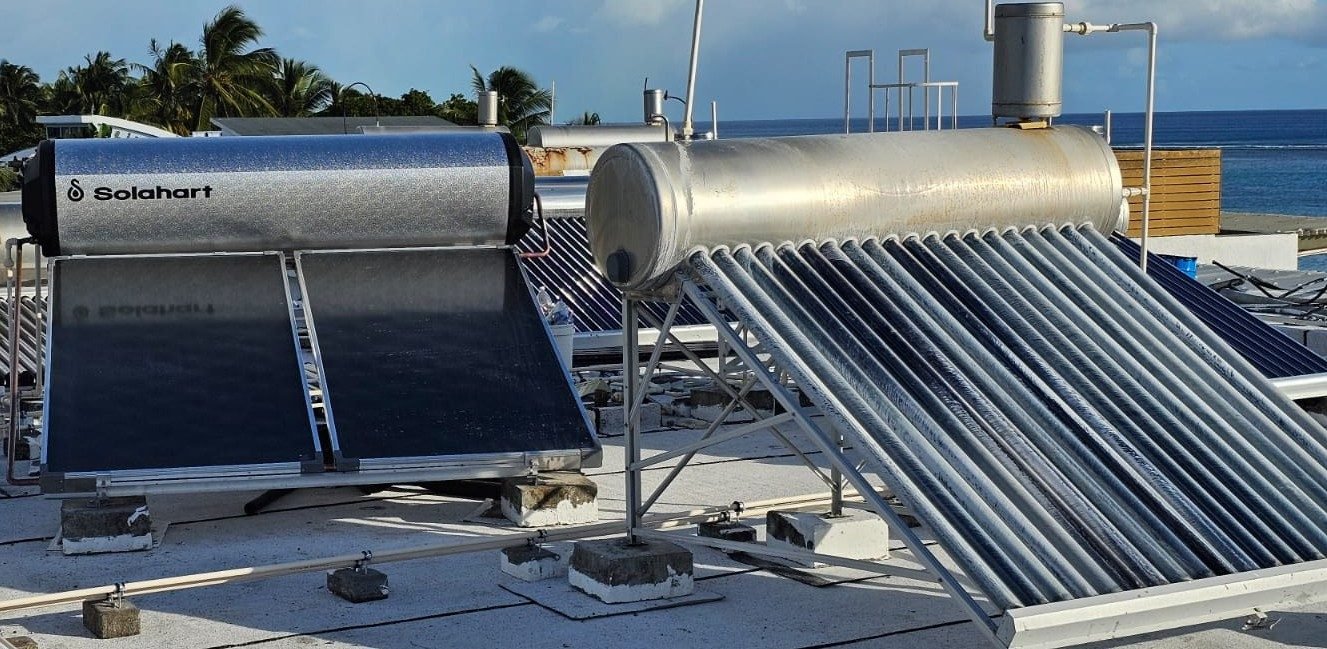
The rust and calcium staining seen on so many Mauritian rooftops.
Why it matters
The daily spill from an open-vented system runs down the casing and causes the rust and calcium staining you see on so many Mauritian rooftops.
It is not a defect or poor installation. It is how that design behaves.
The catch
Many vacuum tube systems can take mains pressure, so they can honestly be sold as “high pressure”. But most vacuum tube systems sold here are open-vented, so they spill hot water over the tank and tubes by design.
“High pressure” on a brochure tells you nothing about whether the system is pressurised.
What we supply
Every Solahart solar water heater we supply (the L Series, split systems and Sunheat) is both high pressure and pressurised.
The L Series, split systems and Atmos Eco heat pumps have both valves: an expansion control valve (ECV) on the cold inlet and a TPR valve on the hot water outlet. Sunheat has the TPR valve.
For the technically curious
You may see “open loop” or “open circuit” on a Solahart data sheet. This describes the collector, not the tank.
The collector
Open loop
The water heated in the collector is the same water that flows to the tank and out of your tap.
The collector
Closed loop
A separate fluid (usually water mixed with antifreeze) circulates through the collector and passes its heat to the tank water through a heat exchanger, so the two never mix. Closed loop designs are mostly used where freezing is a risk.
The tank
Open vented
A different thing. It describes a tank design, which is open to the air so that expanding hot water spills out.
The Solahart L Series, Split and Sunheat systems we supply are open loop systems.
In short: open loop or closed loop describes the collector. Open vented or pressurised describes the tank.
Three questions to ask any supplier
“Can it take my pump or mains pressure?”
“Is the tank sealed, or open to the air?”
“Where does the expanding hot water go?”
If the answer to the last is “out of the top of the tank”, you know what you are buying.